Strat Chat - Chunking
Punch chunk love

I don’t know about your family, but when my father-in-law tells a story you need to strap yourself in. There are B-plots, C-plots and sometimes all the way out to Z-plots. I love him to death but no human being can follow a story that long and intricate then actually comprehend it all. Similarly, in my undergraduate degree I was forever faced with 3 hour lecture where I’d tell myself “this time is different” and I would pay attention and take notes the whole time. Valiantly though I tried, usually after about 20 minutes I would start pondering about the drive home or what was going to happen on Survivor that night.
I take most of my quotes from respected academics and qualified professionals. However, I also take a scary amount of quotes from cartoon characters, especially one particular dog dad who has become one of Australia’s biggest exports of the past decade:
Pro tip - keep it simple. Kids switch off if you talk too long. Bandit Heeler, Show and Tell (2025)
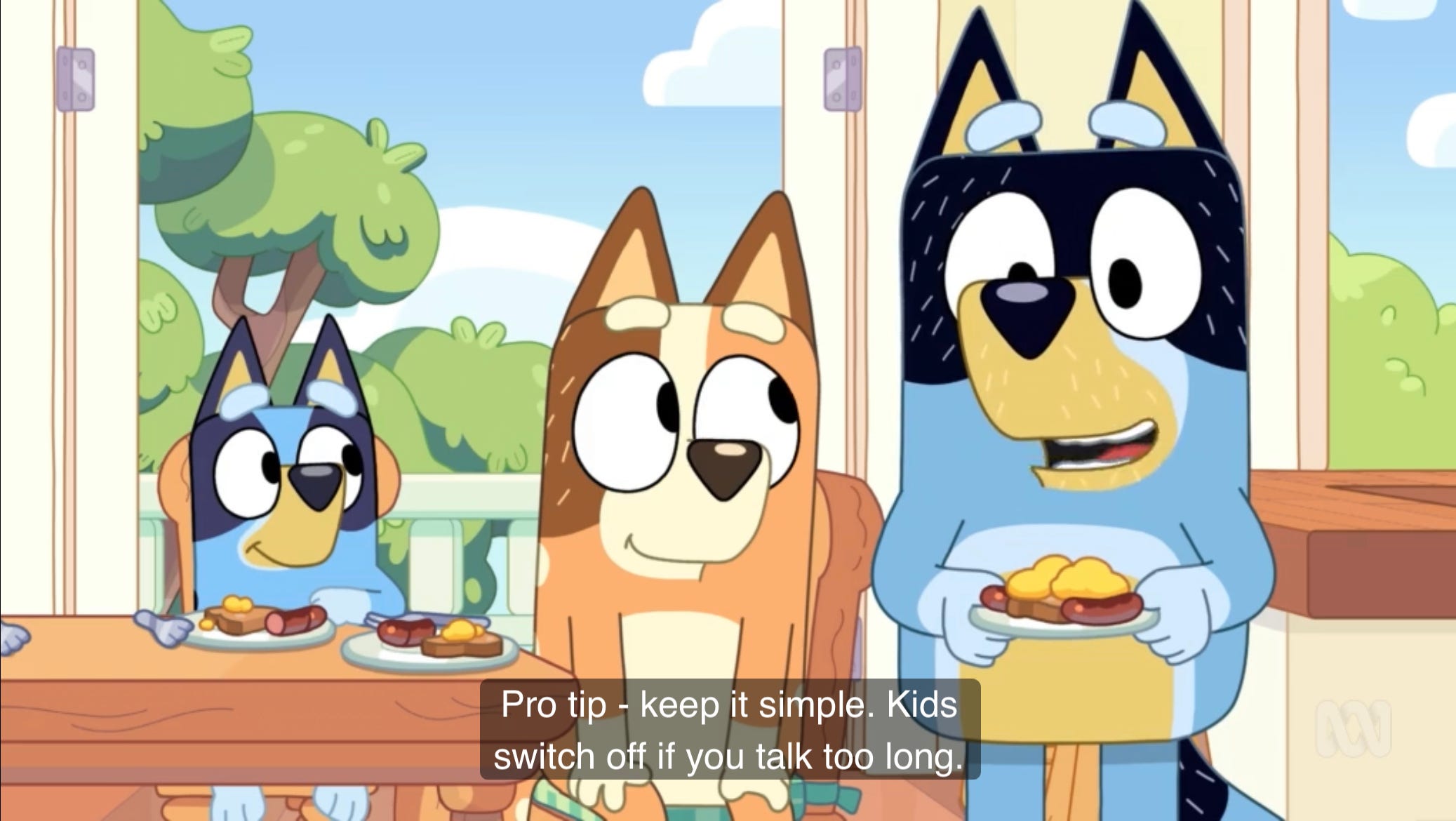
This simplistic statement really encompasses one of our greatest battles when it comes to planning and executing instruction. The human brain is severely limited. Working memory of an average person can range between 3 and 7 novel items as stimuli before it becomes overwhelmed and cannot process any additional information. We remember what we think about, but we can only think about the things we hold in our working memory. If a student is presented with too much stimuli all at once or over a period of time without stopping to rehearse the information via a check for understanding it is unlikely anything will be retained.
As teachers we know what we want the students to know. But the act of imparting that knowledge on to them is tricky. To say you want students to understand the quadratic equation is great, but the ability to break it down into small digestible parts is what sets apart the most effective teachers.
Achieving this is known as chunking. Grouping smaller pieces of information which when added together makes up the whole. This is nothing new. We’ve been exposed to it our whole lives. Growing up in the 1990’s I can still recite the phone numbers of Pizza Hut (13 11 66) and Lube Mobile (13 30 32) because their ad campaigns knew we couldn’t look up the numbers online and therefore had to relentlessly barrage us with their telephone numbers in catchy chunked jingles until we had no choice but to have it etched into our long term memory whether we liked it or not1. We still do this now with mobile phone numbers where we turn 10 digits into 3 novel items by chunking the numbers into 4-3-3. We even do this with our credit card numbers as we turn 16 digits into 4 as well as memorizing the expiry as a date and the CCV as a whole number to mean that a card holding potentially 23 digits is now only 6 items to remember as we impulse buy another set of mini whiteboards online at 2am because the school is taking too long to order more class sets.
Chunking in Practice:
How to chunk the delivery of instruction in your class really comes down to the expertise and experience2 of your team. For a new career teacher this can be very difficult as they may not be able to see all of the small parts that create a large concept.
If you’ve ever built furniture from a flat pack you may have experienced what they sometimes refer to as the ‘exploded diagram’ of the furniture which shows every single piece, nut, bolt and nail and how they all fit together.
If you had built that furniture before it would make total sense, but every time I see one all I feel is stress as I become overwhelmed by the 54 steps of the construction project all placed on the same A4 page. The pages that follow then do an exceptional job at breaking the process down into small chunks until you reach the final product.
Interestingly however, following an instruction manual may chunk exceptionally well but they are not great for learning. If you gave me all of the materials for an IKEA Kallax shelf of which I’ve built half a dozen before, I would essentially be going in blind.3
Chunking is only half of the battle.
Let’s look to a relatively simplistic example from a Key Knowledge point from Unit 3, Area of Study 3 in the VCE Business Management Curriculum:
· key elements of an operations system: inputs, processes and outputs
This one really does a lot of the work for you. We know what the bigger picture for this lesson is; to understand the key elements of an operations system. We also know the smaller parts to get to that whole as they’ve been broken down into inputs, processes and outputs.
In terms of how this then specifically chunks into a whole lesson that builds into a whole it probably looks like this:
Do Now activity linked to prior lesson on the relationship between operations management and business objectives.
Recap of prior learning
Check for understanding on that prior learning.
Set learning objective and success criteria
Introduce key elements of an operations system.
Explicitly describe what inputs are and provide real world examples of inputs.
Model responding to a question on inputs. (I do phase)
Check student understanding of inputs. (Eg. one input used to make a pizza would be… or which of the following is not an input in a cake?)
Explicitly describe what processes are and provide real world examples of processes.
Check student understanding of processes with a scaffolded question similar to the previous model. (We do phase)
Check students overall understanding of processes. (Eg. what would be a process for the following goods or services?)
Explicitly describe what outputs are and provide real world examples of outputs.
Check students understanding by having them complete a similar question to the previous model with no scaffolding. (You Do phase)
Bring it all together by summarising the content holistically and modelling a worked example of an exam style question.
Students complete independent practice while teacher circulates.
This can (and should) be broken down even further as although 15 steps in a class seems like a lot. In a 60 minute class that means you’re spending roughly 4 minutes on each item and students are only responding around 8 times if you take all of this at face value. In reality, even in those small chunks of new learning there should be frequent4 opportunities to respond to ensure that student attention is focused and that we are optimising cognitive load rather than overwhelming it.
So much of the work that we do in teaching is sequential in nature. That is, each item that we learn builds on the item prior to it and therefore if we do not break information down into these small palatable chunks then we are building a house without laying the foundation. It might look pretty for a few moments, but it’s likely to come crashing down the moment the wind changes or the big bad wolf of assessment shows the true learning that has occurred.
I still have regular invasive thoughts of 1990s tv jingles in Australia. “For everything mechanical we’ve got it! They’ll fix the car! Lube Mobile will come to you 13 30 32, that’s 13 30 32” “one three double one double six, one three double one double six, one three double one double six. Pizza Hut delivery!”
Annual reminder that expertise and experience are very different things.
I’ve seen/heard David Didau refer to this as SatNav teaching where we blindly follow steps to the desired result but do not remember or understand the steps to get there nor understand how they connect.
I prefer to use the term ‘relentless’
I love how many progress checks there are in the example. Some kids ask why so many. I tend to respond its like building blocks. Missing pieces don’t seem to work well to create buildings. So let’s check their in place. If a reteach is required it’s ok because maybe we just didn’t get it across the way we thought it would work.
Side note: love a process (operations) driving an explanation for the chunking, which really is a process or production line! Was that intentional? Nice work.