Strat Chat - Circulation
Moving with purpose

Circulation is an important aspect of so many elements of our lives. Our blood, our currency, our air and even our water. This circulation stops things from clotting or getting stagnant. Our blood circulating is able to bring important nutrients to areas of the body which need them. Our air circulating means that carbon dioxide can be converted into clean oxygen by plant life and allow us to keep on breathing. Our money circulating means that no one person has too much of… wait no that one doesn’t work under capitalism.
In teaching, circulation is more about the way in which we move around the room with purpose. This may be during instruction or during checks for understanding and independent work. Moving around the room is mainly conducted for two specific reasons.
Using proximity for managing behaviour.
Moving in a route designed to visit students based on their expected level of need.
As students work, circulate with one question in mind: "Is this student's response showing they understood the explanation — or are they just completing the task?" Note two or three students whose work you'll refer back to in the whole-class discussion. Use what you find to shape the next ten minutes. - Jamie Clark (DistillED)1
Using proximity for managing behaviour.
As teachers we do not want to find ourselves bolted to our desks at the front of the room as this gives students additional opportunities to stop paying attention and display off-task behaviours.
The physical presence of a teacher is a powerful thing. It is amazing that the mere movement of a teacher towards the area of disruption or off-task behaviour can lead to a quick, positive change in behaviour without as much as a single word from the teacher. The authoritative aura emitting from their body radiating through and correcting students from presence alone.
Beware a mutation of this circulation though. Sometimes circulation for behaviour management can be misinterpreted and suddenly the teacher becomes the bus from Speed. Unable to ever stop or slow down for fear of the class eruption into negative behaviours. The teacher then becomes somewhat of an endurance athlete as they complete a 5k walk in a 60 minute class without so much as breaking a sweat. The question here becomes, what is the circulation for? A teacher doing too much circulation can be as much of an avenue for disruption as not circulating at all.
Ideally, by building strong routines and high expectations of your class then the requirements for circulating to manage behaviour will actually be minimal. This actually has the further benefit of making the movement more powerful when it is utilized as the students know it doesn’t happen regularly.
Moving in a route designed to visit students based on their expected level of need.
The alternate and more ideal use of circulation is that once behaviour is settled you can begin to use circulation to help scaffold for students to meet them at their point of need. Ideally in explicit teaching we’ll be pitching instruction to meet as many students as possible and not assuming any prior knowledge unless it has been previously taught by you. This teaching will then often lead to many checks for understanding throughout the lesson where the students are provided with an opportunity to respond and then will have anywhere from 10 seconds to a few minutes to respond to a problem. As soon as students begin their independent work the teacher needs to chart a very deliberate path around the room. It would be easy to default to moving straight to the students who definitely know the answer which would make the teacher feel like every students is currently completing the work to a high standard. However, this cognitive dissonance does not only harm equity, it also means that some students may never even get started when they’re capable.
Instead, the teacher should first conduct an exaggerated scan of the room and then move immediately to the students with the most need. This allows the teacher to provide verbal scaffolds if needed so that the students can attempt the learning at the same level as the other students. While these students get started this now frees the teacher up to continue circulating and then checking in with students who may be getting stuck at points further along in the question. One of my favourite elements to do in these circulation walks is that when I am consistently seeing something positive in the work of most students, I will loudly mention that praise to the whole class to positively reinforce the work of the students who currently have that in their response while simultaneously reminding the other students to think about its inclusion.
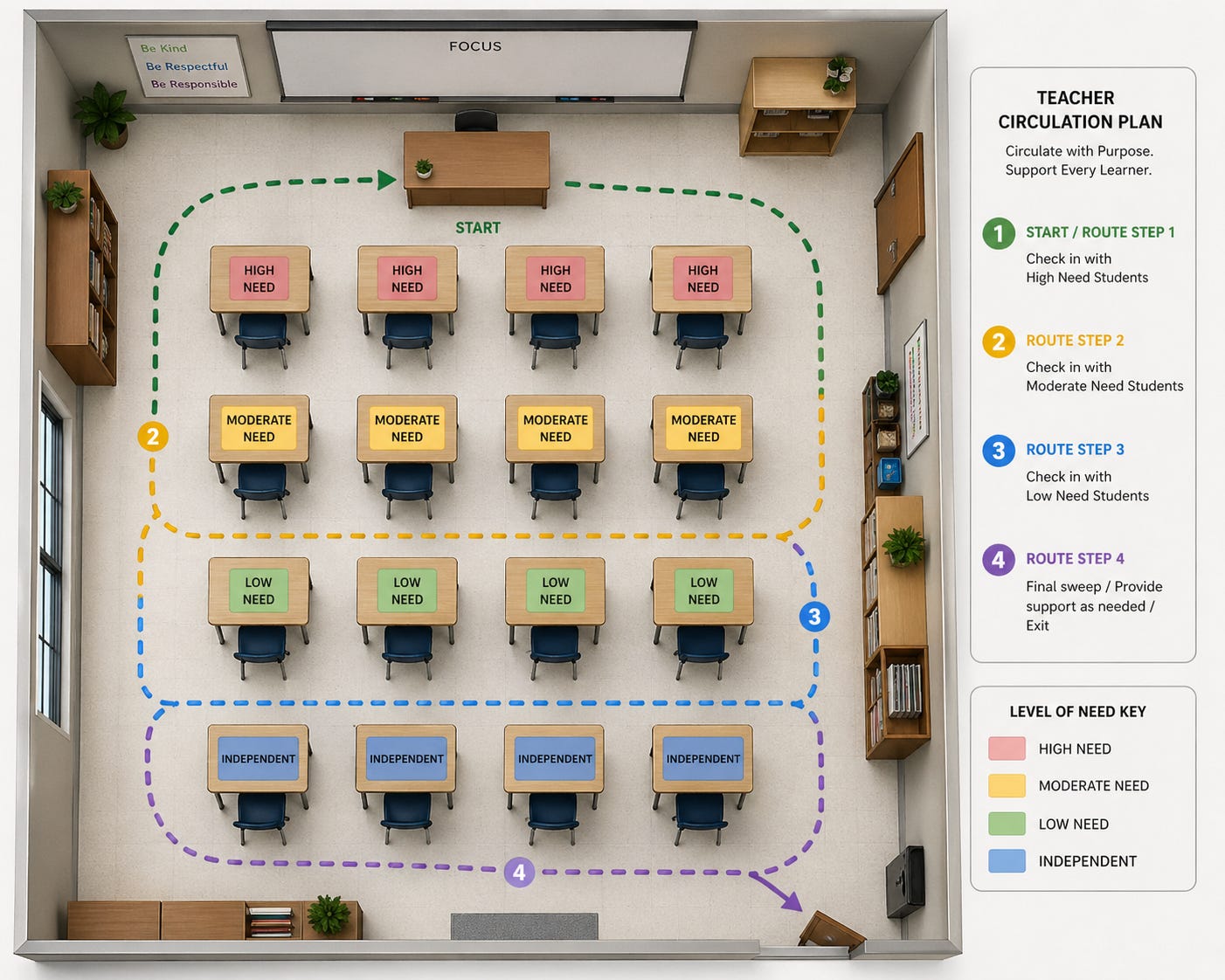
During this circulation about the class you are also able to inform how you will then follow up any check for understanding with cold call questioning of the class. Especially if using mini white boards we are able to quickly sample the thinking of all students in the class during our circulation and begin to formulate a plan about who is going to be asked which questions at specific points of the lesson. This means that when some students earlier in the learning can be provided with success when you know they have been able to show significant understanding in the task.
Beware this route becoming too ingrained as habit and over scaffolding for some students. It is really important to remember that the same students will not always need support and it is important that we only provide support as is needed to gradually move our students towards independence. We also must remember that our more independent students may sometimes need scaffolding based on a variety of factors which could impact their ability to attend to the learning on a given day.
As teachers our presence has power. The way we move around the room can have significant impacts on behaviour and student effort. When we are not tethered to the front of the room it shows the students not only that they are accountable, but also that we greatly care about the progress which they are making. Our movements are a reminder of the routines and high expectations we have put time and effort into creating and our focus on creating improvement for every student, every lesson.
https://newsletter.jamieleeclark.com/p/poor-proxies-4-the-calm-classroom-illusion-part-4-of-6?utm_source=newsletter.jamieleeclark.com&utm_medium=newsletter&utm_campaign=poor-proxies-4-the-calm-classroom-illusion-part-4-of-6&_bhlid=3178561be37b85a9470033c432710e60968ba79f