Technical Difficulties
How my views on Edtech are slightly shifting (but not too far)

Early on in my writing on Substack I posed the question “Is it right to become a luddite?” in reference to abolishing the use of Edtech in the classroom. This came off of the back of reading The Digital Delusion (of which is now out of print and soon to be re-released). which emphatically motivated me to push for the complete removal of devices from schools. A position in which I still mostly believe in, however I have taken a few steps back in favour of technology and the benefits it can provide.
I think to explore this in a way which is fair and balanced we need to separate the broad definition of EdTech into the various categories it can be conflated to mean. Devices, digital platforms and artificial intelligence. All of which have their positives and then also terrifying negatives when it comes to learning.
With any technology we use in education there needs to be one clear guiding question:
How does this work in service of the learning?
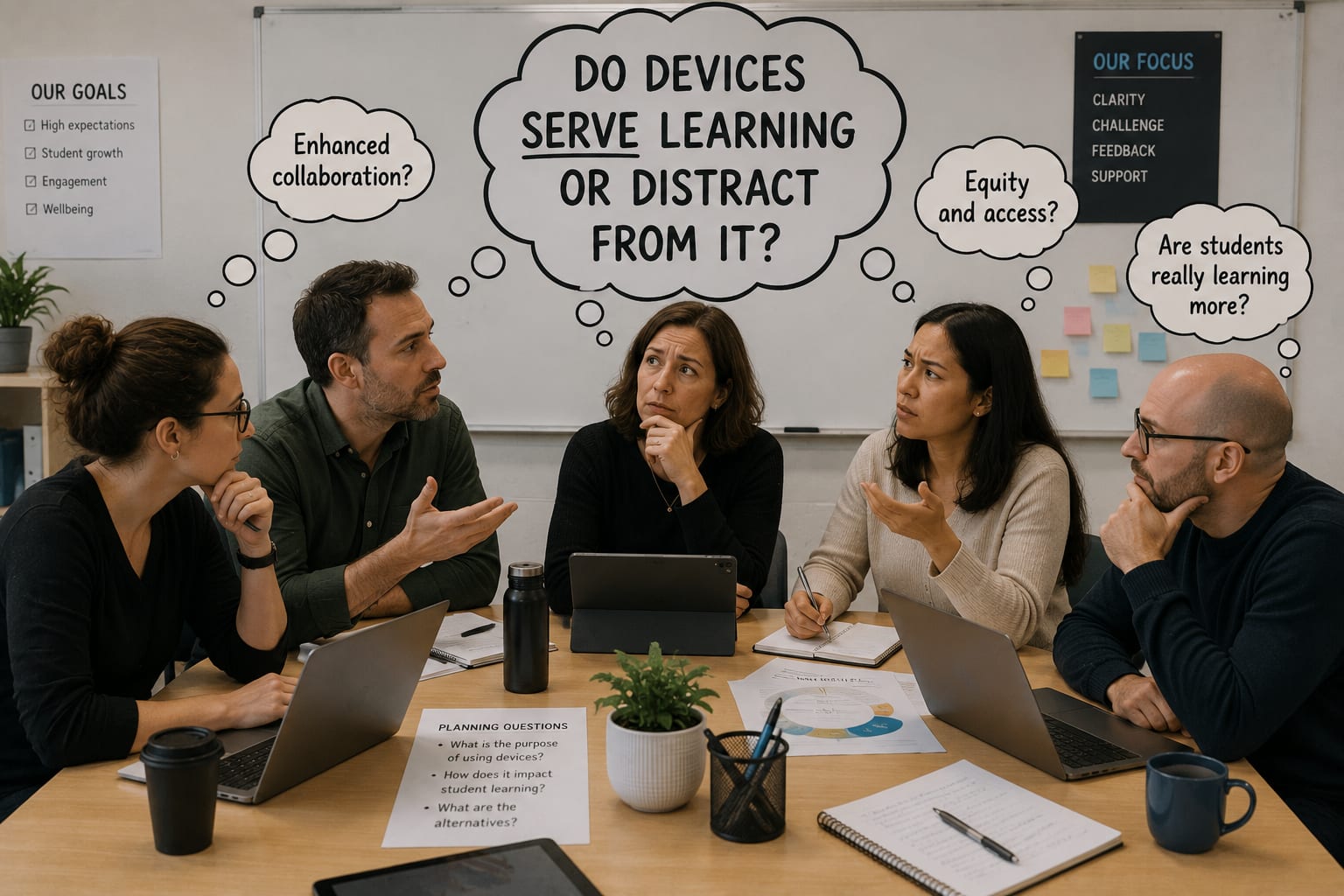
Can the learning occur to the same degree without the technology? If it can, then why is the technology being used?
Is it because the school has a Bring Your Own Device program? If so that’s a pretty weak rationale to base your planning decisions on.
Is it because you’ve sunk a large chunk of your budget to a learning platform? Again if it’s not servicing the learning then that is a questionable decision.
Is your solution to AI use in student work to just be glad they submitted anything at all? Then that’s a low bar you’re setting for your students.1
Proponents of devices in schools often claim a number of different arguments for their utilization.
Students need digital literacy for their future careers.
Students need to be able to look up answers to problems.
Device use is more environmentally friendly to limit paper use.
Devices and digital platforms are more able to personalize learning.
Digital devices are more accessible for students with additional needs.
To address points 1 and 2, I don’t actually think the way we utilise technology at school currently teaches digital literacy. I’ve lost count of the amount of digital assignments I’ve had submitted titled ‘Document27.docx’ or the times I’ve been called ‘bruh’ or ‘cuz’ in an email. These very same students can also jump through a series of very technical hoops to watch the NBA playoffs bypassing all layers of network security put in place by the school.
Just because I can look something up, does not mean I’ll be able to understand it either. A teacher as an expert has countless ways to rephrase and reteach content to reach various points of need while also being a reputable source. Meanwhile students reading the Google AI summary may discover that it is healthy to smoke cigarettes while pregnant or that it is better to walk to the local carwash rather than drive. I could currently look up how the machine which separates plasma from blood works and have no understanding at all of the scientific or medical jargon used throughout means. I may pick up on the fact it has something to do with centrifugal forces but how it filters one yellowish liquid out of another red liquid before returning the red liquid into my body is basically magic in my uneducated view.
For point 3, I do admit that paper resources are damaging to the environment and that is a difficult dilemma to circumvent. One of the reasons I used to be pro-device all of the time was that it would be better for the environment. However, when you also take into account the energy and water consumption of AI use as well as how difficult it is to dispose of old electronics while also accounting for the damaging level of distraction they can bring means that a little deforestation goes a long way for learning.
In terms of point 4, digital platforms certainly do have the potential to personalize student learning, however I would also argue that outside of very specific circumstances that this is rarely closing the achievement-gap and is often actually causing the gulf to widen. I’m yet to see a platform be able to accurately diagnose student challenges and adaptively address the misconception and build towards mastery. Many platforms simply lower the bar to ensure success and therefore continued engagement with the platform.
Finally with point 5, devices certainly do help with accessibility, that is nearly impossible to refute. Students with a motor difficulty can use speech to text. Visually impaired students can alter text size and font to access the learning better. My devils advocate here would be that too often we accommodate with devices rather than using them to meet a student’s functional needs. A device for a functional need is an incredible equity tool. A device because a student prefers typing means that they are missing out on the benefits for learning that handwriting brings.
Devices:
Let’s get this out of the way very early in the piece. The number one reason we should get devices out of classrooms the majority of the time is due to the level of distraction they can cause. When every notification received by a student interrupts cognitive processing for roughly seven seconds2 you’re really just providing an invitation for students to display off-task behaviour. When attention is the currency of learning, it is introducing a tool which actively competes with you for it and it is a fierce competitor. You want to teach the student some ‘BoRiNg MaThS’3 while their friend Mr Device is offering them whatever their heart desires. Games, messages, streaming TV. You name it and Mr Device is going to give it to them if it means they pay him more attention than you.
“Cast them out” - Greg Ashman (When Will They Learn, 2026)
Furthermore if students are typing all of their notes, essays etc. They are then missing out on the cognitive friction caused by handwriting which causes us to process information slower, for longer and therefore lead it to be more likely to be retained.4
Then what is the argument FOR devices?
For expert learners conducting research with tightly bounded questions or criteria it can be a great tool for deepening understanding or exploring areas of interest. For students with specific disabilities it can be a great tool for accessibility. Otherwise, I’m at a bit of a loss for when they should be the default for the classroom.
Digital Platforms:
Digital platforms for learning are big business in 2026. Some are excellent. Some are glorified games which focus more on student engagement than student learning.
I often equate digital learning platforms to the infomercials you’ll see on late night TV or morning shows. They’ll always start by presenting you with a problem which definitely exists, but they will showcase it in such an exaggerated way that it seems that you won’t be able to go on without a solution. The solution of course, is their platform. In this case though the platform rarely comes with a free set of steak knives.
In previous pieces of writing I probably came down too harshly on digital learning platforms. However, I do still believe that any platform where a student is responding in written form digitally is fraught with danger. This is due to the ability to copy and paste from other sources, write a nonsense answer and submit or use AI to do the work for them. These platforms are marketed to reduce the workload for the teacher and yet to check this work with the fine toothed comb required is going to take far longer as a teacher clicks through each students profile and answers to ensure they completed it properly. On this point however I would like to reiterate my previous concerns about platforms which ‘gamify’ learning where often student attention is drawn more towards the gameplay itself than what they are supposed to be building or retrieving knowledge about. My favourite example of this has and always will be the use of a Kahoot as a ‘fun quiz’ for students for revision. Is there any reason for the revision quiz to be online? Does the quiz provide meaningful feedback? Can students opt-out at any time? Can the students just guess? I have said it many times before but it is always worth repeating
“Kahoot? I’d rather ka-shoot myself in the face” - Shaun Brien
The platforms do however often have many other benefits. One of which is the provision of high quality video lessons or pre-built teaching resources which is so useful if a teacher is absent so students are left completely to their own devices.5 I would then still always prefer students complete the comprehension work by hand afterwards.
Another benefit of some digital platforms such as the flashcard programs which have some into existence such as Anki, Brainscape and more is that they are able to utilise AI algorithms to battle the forgetting curve and create retrieval practice for students which is far more accurate for each individual (personalized learning) than a teacher would ever have the time to be able to plan for. Due to this I am a massive supported of using these flashcard platforms as a homework task (however, again, I ask students to write their responses by hand in a book).
Artificial Intelligence:
The elephant in the room (with one too many toes in the image for some reason).
There’s no escaping AI in 2026. We’re in this weird liminal space at the moment where AI exists, we acknowledge that almost everyone uses it, but the policy and procedure around it lacks clarity and consistency.
In my opinion AI is an incredible digital assistant. It is able to take my thinking and then do the tedious work to create the output I want in a fraction of the time, freeing me up to complete more important work.
This however, is not always the norm.
One of the biggest fears I have with AI use is something that is already happening widespread in schools everywhere. Not only are students using AI to complete the work for them (such as this article about Mazenod College which acts as if the Year 12 cohort at this school is out of the norm) but then I have seen more and more educators use AI to plan and create their lessons from scratch. An important distinction to make here is that AI can be great to help plan lessons or create resources that you have put deep thought into. However, what I have seen more of is clearly AI lesson plans which barely connect meaningfully to the curriculum which sets the students work which is then also completed with AI and we’ve created a cycle of learning where the only thing that needs to think is AI.
When AI replaces thinking, learning dies.
On the other hand, new frontiers in AI for retrieval practice and tutoring students on a one to one basis seems incredibly promising. ChatGPT, Gemini etc do not really have the capabilities to do this well, but if a teacher was able to create an LLM which understands their curriculum and assessment well then it would be able to have students submit their responses to questions and gain instant targeted feedback which would improve student learning as well as decrease teacher workload. I love the idea of this but do think the technology still has a way to go before I would fully trust it in this way.
Another area which shows incredible promise is the ability of AI to mark student homework, comprehension questions or formative assessment tasks. The amount of hours this could potentially save teachers while also providing diagnostic data about what teachers should focus on next and areas for growth could reap incredible results.
Having tried to start a conversation about device use in school within my leadership team many times over the past few years it can be incredibly difficult to break ingrained routines and behaviours.
The important thing to remember with anything we do in education is
Does this task or tool service learning.
Does this device improve or harm student outcomes?
Maybe we don’t need a full ban on devices. We are not living in a luddite commune. But we should think carefully about when and why those screens come up.
Note: Since writing this post it has been announced that in the context I teach (Victoria, Australia) that limits on device use of 90 minutes will be implemented for Primary Schools and planning for device-free time will be expected for all Secondary Schools from 2027. What this will look like is not currently clear, however it is a great step in the direction of forcing questions about when and how devices are used in schools.
Shout out to the IB for solving their AI problem by just allowing students to use AI.
https://www.sciencedirect.com/science/article/pii/S0747563226000233
Their words not mine.
https://pmc.ncbi.nlm.nih.gov/articles/PMC11943480/
As someone who has recorded and makes royalties from digital videos for a platform I would be remiss not to disclose a level of conflict here.