The Inclusion Illusion
If it’s not explicit, you are complicit.

A wise educator recently said “equity lives in instruction” which struck a chord with me.
Today, we’re going to explore what really works in inclusive education and some of the illusions of inclusion which look and feel inclusive however further disadvantage our most vulnerable students. I’m going to loosely follow the format of Instructional Illusions by Paul Kirschner, Carl Hendrick and Jim Heal as a homage to how excellent of a teaching resource that book has become.
This post is not to say that there is one correct instructional methodology, and all other instructional methods are wrong (the tagline as always was created for witty wordplay and shock value). There is a place for all types of learning at different points in time, however when it comes to Inclusive education, time and time again evidence has shown empirically that if we want to truly include students that explicit teaching methodologies work within the cognitive framework of all students to maximise their learning.
My role in my day job is a Learning Specialist for Inclusion and in Victorian schools he have had a roll out across Victoria from what used to be the Program for Students with Disabilities funding where students would be provided with a predetermined amount of funding for their support based on a diagnosis from a specialist to the Disability Inclusion Profile system where schools must document 10 weeks of specialist informed adjustments made for a students functional needs across 31 domains which is then scrutinised by a facilitator from the government before a funding decision is made. These 31 domains are ranked on a scale from present environment (no adjustments), differentiated teaching, supplementary adjustments, substantial adjustments and finally extensive adjustments. To be successful in funding for a student you are required to have a combination of 8 substantial and extensive adjustments across the domains or at least 3 extensive adjustments.
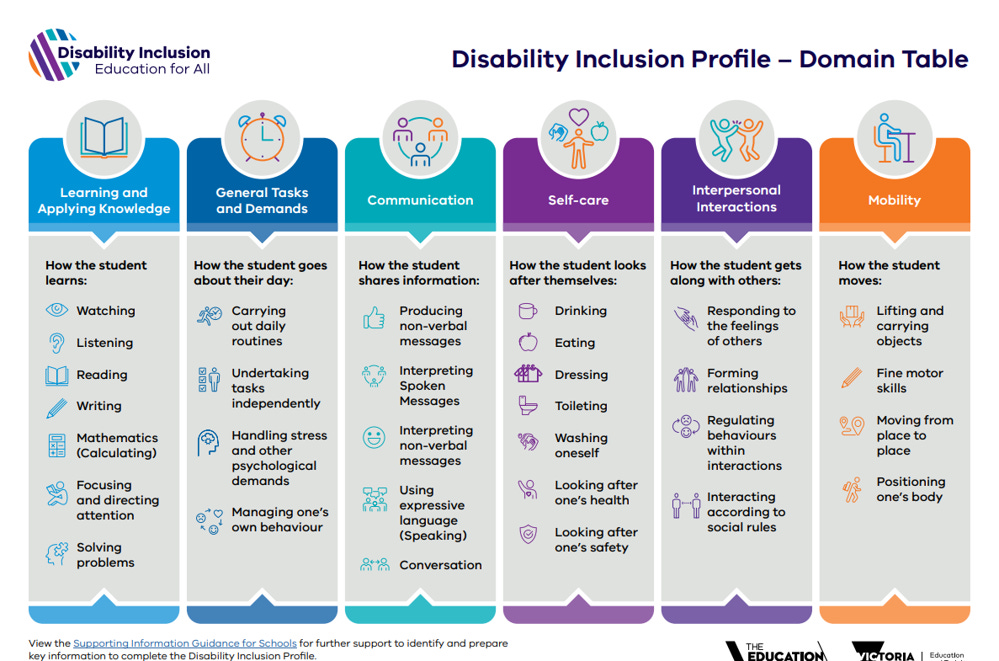
Despite being a significant administrative load added on to schools to create this documentation throughout the year to seek funding they may not be successful in applying for there is some merit to the process. Previously, when schools would simply receive x amount of funding per student, there was so real way of knowing if that funding was being used to actually support that students’ functional needs. It created a system where students would often sit away from the rest of the class with one-to-one education support either colouring in or completing busy work rather than bridging the gap in learning that currently existed.
This new system and the level of evidence required to gain funding does mean that schools need to take a more serious approach to true inclusion in the classroom (at least in their documentation).
The downside? Systems and frameworks that ‘support’ inclusion are very trendy and profitable for businesses and schools do not necessarily have staff with the required skills to teach to students more than one year delayed in their numeracy and literacy and this creates significant challenges for true inclusion.
Inquirin’ will get those brains firin’:
Too often have I seen teachers who when presented with a student with additional needs who needs a individualised learning plan ends up being provided with inquiry project after inquiry project. Sometimes relevant to the class they’re in, sometimes about areas of interest. Inquiry is fraught with issues when it comes to inclusion. As I quote in almost every post “Knowledge is what we think with” (Greg Ashman) and novice learners struggle to know what questions to ask when required to inquire as they do not have the base knowledge to build their questions from. Expert learners on the other hand can benefit from strong prior knowledge and thrive even without prior instruction which then creates a wider channel between learners in the classroom.
“Unlike experts, novices – and in this respect almost all students – lack the conceptual frameworks necessary for meaningful discovery” - Paul A. Kirschner, Carl Hendrick, Jim Heal. (Instructional Illusions, 2025)
All of this is not to say that inquiry learning has no place in the classroom however it can never be the starting point. (it is even a requirement for some VCE units and all IB units)
Yearning for Project-based Learning:
Project based learning essentially provides students with a long-term problem to solve where they will develop the knowledge and skills required for the unit through the completion of this project.
“Project-based learning (also known as PBL) is a teaching strategy that focuses on real-world problems and challenges using problem-solving, decision-making and investigative skills. It is increasingly being used across disciplines because of its capacity to engage students in developing self-directed learning skills. Projects range in scale and type. It can be focused on academic, personal or industry problems and involve external stakeholders such as clients or partners (Thomas, 2000).
From https://itali.uq.edu.au/teaching-guidance/teaching-practices/active-learning/project-based-learning
Characteristics of project-based learning typically include:
The presence of a driving question or central concept.
The presence of a task, a process, a product and a reflection.
Students learning through investigation of defined goals supporting knowledge building.
Student-centred projects with teacher facilitation, guidance and/or mentorship.
Projects that have significance to the student.”
Again, this approach sounds moral and accessible to students, however we run into very similar roadblocks to inquiry learning. Students without the required base knowledge required for the project are unable to effectively investigate their problem and therefore can waste countless hours of learning time attempting to discover answers to their questions or potentially worse learning a misconception which is incredibly difficult to correct in future. Also, students coming from low literacy backgrounds based on their additional needs or diagnosis may struggle to find the right words they need to seek answers to their questions or may not be able to decode and understand the complex resources they find. Another issue which can occur when students are left to complete open-ended projects with a driving question or central problem to solve is the difficulty of choice. Too many potential options of projects for students to work on can lead to additional cognitive load and therefore limit student capacity to learn as they become overwhelmed by choice.
Universal Design for Learning:
Cast Institute in the United States created UDL and they state “UDL is a framework to improve and optimize teaching and learning based on what we know about the human brain. Each brain is made of billions of interconnected neurons that form unique pathways. Like fingerprints, no two brains are alike.
Educators face daily challenges in planning for diverse learners. However, learner variability is predictable, and we’ve developed prompts and principles to support educators – the CAST UDL Guidelines.”
Importantly UDL is not a pedagogical framework like explicit teaching or inquiry learning. It is a framework that they believe will maximize inclusive learning. Do not get me wrong, in theory UDL sounds great. It sounds moral. It sounds easy to implement. But in my opinion it leads to a lethal mutation of true inclusion more often than not. When I first experienced an hour of professional learning about UDL the presenter explain UDL with the description that “regular differentiated teaching is like a set menu at a restaurant, while UDL is more like a buffet where you can have whatever you’d like”. Firstly, it is rare that the quality of a buffet is in line with a set menu. Secondly, the key mutation I’ve seen in UDL is that schools begin to address student learning preferences rather than functional needs. Under UDL I have seen schools mandate that students use their device to type and communicate in class despite their being no specialist recommendations for this to occur. The student can still write by hand, they just prefer not to, often because they find it challenging. This is a bandaid to cover a bullet wound.

The research around the effectiveness of UDL is very interesting, despite there being numerous positive meta-analyses about its impact, when you delve deeper into the results of these students, they almost always refer to student surveys of engagement or enjoyment of class rather than student learning growth. It’s a self-fulfilling prophecy if you give students exactly what the will prefer that they will enjoy class more, but this is supposed to be design for learning… are they learning more?
Another lethal mutation I see come from UDL is under their heading of providing learners with ‘multiple means of representation’ where they say “In short, there is not one means of representation that will be optimal for every learner; providing options for representation is essential”. I find this challenging when the department of education in Victoria has been promoting UDL as a tool for inclusion while also pushing for the implementation of explicit teaching for the Victorian Teaching and Learning Model 2.0. We know from cognitive load theory that students achieve learning most effectively when presented with a small chunk of new Learning, checked for their understanding via posing the whole class a question and throughout this process ensuring to focus attention and minimize any extraneous load. Now obviously if a student has a diagnosed vision or hearing impairment, then steps need to be taken to alter resources so that the can engage with the learning on the same basis as everyone else (addressing the functional need), but the idea that every student should be able to engage with the learning in the medium they feel most comfortable sounds like a nightmarish burden for staff planning and workload as well as for meaningful formative assessment during class. “This means focusing on universally effective strategies rather than pursuing approaches which emphasise personalisation (like debunked ‘learning styles’ or certain tenets of Universal Design for Learning) which lack robust evidence (Boysen, 2021; Pashler, 2009).”
Unmasking the Illusion:
The following is taken from Explicit Instruction by Anita Archer and Charles A. Hughes.
“In 1989, Christenson et al. summarized findings of their research on instruction for students with mild learning disabilities. Their synthesis yielded a number of instructional factors reinforced the need for well-organized and explicit methodologies for teaching academic content.
These factors included (1) clear expectations about what is to be learned, (2) clarity of presentation), (3) multiple opportunities for student responses, (4) active teacher monitoring of these responses, and (5) frequent evaluation and feedback.
Other factors identified were effective classroom management, creating a positive learning environment, allocating sufficient time for academic instruction, and ensuring a good match between instructional content and student needs.“
Students with additional needs (much like all students) benefit from consistent routines and expectations, an environment which optimises cognitive load, chunked presentation of new learning, multiple opportunities to respond through checks for understanding as well as consistent feedback from their teachers on their responses. If you are suddenly thinking “wait, but I already do many of those things in my classes” that’s because by simply adopting explicit teaching and conducting lessons well then you are creating an inclusive learning environment.
How I believe an Explicit Inclusive Lesson should run:
Lesson Opening
1. Entry Routines:
Regardless of your school setting there can still be significant disruption when students enter class. This can vary from the amount of noise they make coming into the room, how they interact with other students as well as any persistent lateness. All of which can dysregulate students and lead to significant losses in potential learning for all students.
Having a consistent entry routine is incredibly important to set the scene for a productive class. An ideal entry routine would involve students entering the classroom quietly, taking a seat and beginning work on a task related to their prior learning. While this sounds obvious, as teachers we can very easily lose track of managing this important part of the lesson and it can make the rest of the lesson far more challenging to manage.
What should be done if a class is consistently being disruptive on entry? Routines are something which can be explicitly taught and refined. If students are taught how to enter the classroom and then made to exit and re-enter until they correctly follow the routine it is a very simple time investment early in the year to ensure a smooth start to learning for the remaining months.
For more information on entry routines please visit (https://www.edresearch.edu.au/guides-resources/videos/entering-classroom-classroom-management-practice)
2. Classroom layout:
How the classroom is set up has a significant impact on whether or not students are disadvantaged in their learning. Students with additional needs require any extraneous load minimised to ensure they are able to focus their attention on the learning taking place (this also benefits every other student). This means students should have a clear line of sight to the teacher or resources no matter where they are seated in the room.
The argument against table groups:

As pictured above and highly promoted in teacher education, table groups actually further disadvantage students with learning difficulties and further the gap between our strongest and weakest students.
As can be seen in the image, some students will always have their back to the teacher no matter where the teacher is in the room which can make it difficult to maintain focus and attention. Another issue is that all students have somebody directly across from them which can add to levels of distraction during the explicit instruction portion of the class.
The argument for rows:
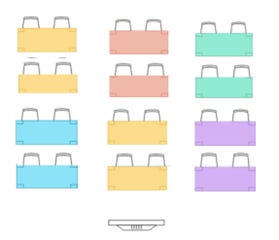
A classroom set up as rows allows a clear line of sight for all students to the instruction taking place. It also gives the teacher far more mobility throughout the room to be able to check for student understanding with no blind spots.
That’s not to say that students are to never work in groups, as this format allows for pairs of students to simply turn around and join the table behind them to facilitate group work within the class without having to rearrange the furniture.
“In another study, researchers found that having the seats in rows also benefitted students with Special Educational Needs (SEN). They found that compared to being in groups, when students’ desks were arranged in rows, their “on-task” behaviours increased from 35% to 70%. The students were also three times less disruptive.”
https://www.innerdrive.co.uk/blog/psychology-of-seating-plans/
3. Starter Activity/Do Now:
The first 5 minutes of class can really set the climate for the whole hour or 2 hours which you will spend with your students that day. Any time wasted at the beginning of the class will compound throughout the year into hours of lost learning. That is why building a routine where students enter the room and immediately commence work on a task (either on the board, in a booklet or handout) can help to start the class productively. This also allows the teacher adequate time to complete administrative tasks such as marking the roll, checking uniform, homework etc.
This task should always be tied to prior learning to test students’ ability to retrieve and apply information from their long-term memory. This allows the teacher to also catch early in the lesson which students are not able to show a strong understanding of prior learning and therefore allows for more targeted intervention throughout the lesson.
4. The accessibility of resources and the classroom.
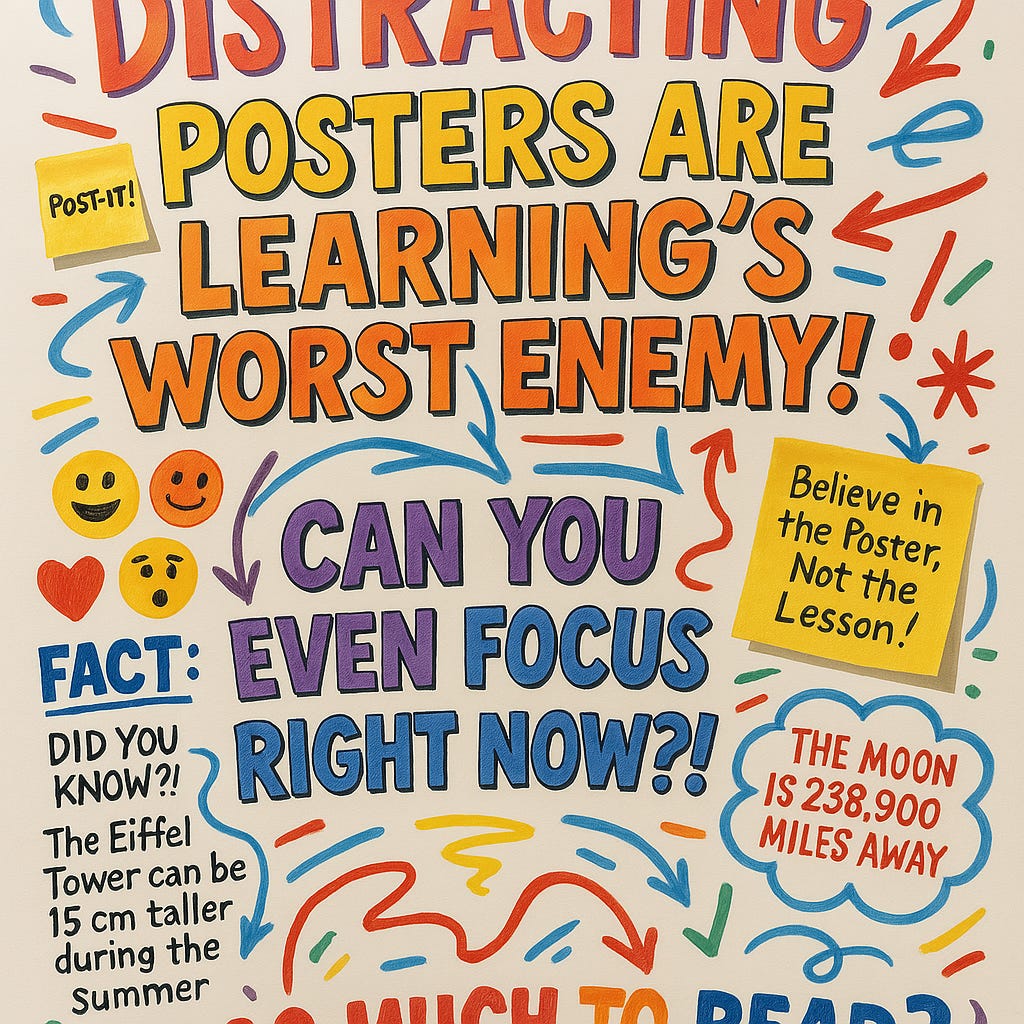
All of our teaching resources should be accessible to all students by default. This means that all resources should aim to be in a dyslexic friendly sans-serif font such as arial, aptos, calibri or opendyslexic. There should be dark text on pale backgrounds for high contrast, and extraneous load should be minimized where possible. This means that resources such as PowerPoints should be formatted to optimize students’ cognitive load by animating slides, so information appears as it becomes relevant, while images/gifs etc. are given their own slides so they are not distracting. One academic recently said it best and I wish I could credit them that they have what they refer to as a ‘mullet classroom’ where it’s all business up the front with minimal clutter or distraction and a party up the back with posters and displays of student work all hidden away from view during instruction.
Goal Setting:
Learning Intentions and Success Criteria should be included in every lesson and explicitly referred to.
Students with additional needs greatly benefit from clear LI/SC because it gives them a learn indication of what they are learning and how they will demonstrate their understanding. It is vital that success criteria are then referred to again throughout the lesson to update students as they should be demonstrating their achievement.
Activating Prior Learning:
Activating prior learning is important on a number of levels for all students but especially students with additional needs.
Firstly, this can act as a form of retrieval which can help offset any forgetting which has occurred since prior lessons as well as rehearsing content to allow for improved storage strength in long term memory.
Secondly, this can help to prime students to make connections between prior learning and new learning and therefore make it more likely that students will understand the new content which is to be delivered.
Prior learning is most often presented as a quick summary of prior lessons content followed by a check for understanding to ensure the majority of the class still understands that content.
New Learning/Application:
New learning and application are directly linked as effective teachers will constantly be moving between the two stages of the lesson structure to present students with a small chunk of new learning before immediately checking for all students understanding of that content.
New learning should be presented in small manageable chunks to optimize the limits of working memory/student cognitive load. This is said to be around 3 to 5 items at a time and the number reduces as the complexity of each item increases. After each new concept as been introduced the teacher should check for full class understanding before moving on. These checks for understanding (CFUs) should be presented in a variety of forms and increase in difficulty and reduce in scaffolding as the lesson progresses.
Some examples of forms these CFUs may take:
1. Choral Response
2. Multiple choice questions
3. True or false statements
4. You be the assessor activities
5. Short answer questions
6. Cloze statements
7. Repeating gestures
This is not an exhaustive list, however, making sure that the modality of these CFUs changes consistently may help prevent students from being fatigued on the tasks. These tasks could be completed in booklets or on mini whiteboards. If a class shows less than 80% understanding on a CFU this may indicate to the teacher that mastery has not been achieved, and some steps may be required to increase student understanding such as cold calling a student to explain their answer or a pair share activity for students to share their understanding. If a class shows less than 50% understanding, this is an indication that there is a misconception which has occurred and that the content should be either re-taught or a worked example should be provided before having students complete a similar task.
This process of chunking learning and checking for understanding helps create a feedback loop that greatly benefits our students with additional needs as they are constantly provided feedback on whether they are on the right track and any corrective action which needs to take place.
For more information on checking for understanding I greatly recommend Caiti Wade’s ‘I already do that’ series on her Substack.
Reflection/Closing the class:
The reflection portion of the lesson structure involves students reflecting on the Learning Intention and Success Criteria to determine whether they have achieved the learning goals set for that lesson.
This may be completed throughout the lesson as the success criteria should be met, or it may take place in the form of an exit pass where students respond to questions based on what they have learned in that lesson.
This can provide teachers with insight into what students currently understand and where any difficulties or misconceptions may have occurred and need to be addressed in following lessons.
This is important for our students with additional needs as many do not feel confident asking for help in front of their peers and therefore may mask their lack of understanding which can lead to a snowball effect occurring across multiple lessons. This allows a teacher to catch any misunderstandings early and intervene to correct them to maximise learning for all students.
Concluding thoughts:
Yes, every human being is different, but how we think and learn is relatively the same based on the neuroscience of learning. Explicit teaching is vital for being inclusive in schools as it provides an environment which actively manages extraneous load and meets students at their point of need and provides scaffolds to push them further. This post isn’t to say that students with additional needs are always appropriate in school populations as in my professional opinion once a student has shown literacy or numeracy delays beyond a few years teachers do not have the time or capacity within a one hour lesson to help both that student and the rest of the cohort to succeed.
Finally, I’d just like to thank a number of people who were vital in helping me collate as much evidence together to support inclusive learning as in Australia we are still very new in this space. Charlotte Peverett for both her ‘Cut the Fluff’ professional learning session as well as her openness to take us on a tour of Lake Colac School and show the incredible work they have facilitated with students with very high needs and the success they’re able to provide for those students. The leadership team at Ballarat Clarendon College who provided me with a year of the best professional learning possible in explicit teaching which I’ve been able to take and apply in public school settings to benefit a wide range of students. Peps McCrae and the team at StepLab for their Inclusive Learning Paper which has been formative to our staff professional learning on Inclusion and changing classroom practice and lastly, the rest of the leadership team where I currently work who are willing to allow me to ignore some of the things the department of education suggest while we try to defeat the research implementation gap and provide our students with the opportunities they deserve.
If you found this post helpful please share it with wider networks as I put so much into making this.