Workload? More like working loads!
Breaking down an average workload of a high school teacher.

As industrial action continues in my state fighting for improvements in wages and conditions for teachers I thought it would be interesting to reflect on all of the activities that take up time in a single day to interrogate what workload can look like for a teacher and leader who’s workload can quickly shift based on changing circumstances.
Monday 27th April, 2026
Arrive at work - 8:00am
8:00am - 8:30am: triage emails and post to all of my classes on TEAMs what we will be doing in our lessons today.
8:30am - 8:40am: go to my first classroom and put out the mini whiteboards and markers and project the Do Now onto the board.
8:45am - 8:50am: Staff Briefing
9:00am - 10:00am: Teach my Year 11 Legal Studies class about Juries in Unit 1 Area of Study 3 - Sanctions. Update students homework completion in my messy markbook and aim to put a mark against each student that is asked a question to ensure that all students are asked at least one question during the week.
10:00am - 11:00am: Teach my Year 12 Business Management class about Materials Management in Unit 3 Area of Study 3 - Operations Management. Again update messy markbook as needed.
11:00am - 12:40pm: Eat lunch while planning lessons for a staff member who is absent unexpectedly for 2 weeks. This involved updating the student planning, finding where resources were and then matching up the instructional resources with the student booklet activities.
12:40pm - 1:40pm: Teach my Year 12 Economics class, very much in the same process as the previous two classes.
1:40pm - 2:00pm: Eat lunch (while have a few conversations about a few issues that have popped up here and there)
2:10pm - 3:10pm: Take an extra class of Year 11 Sport and Recreation. Relatively self-managed but requiring quite a few behavioural reminders throughout the hour.
3:30pm - 4:00pm: Assessment moderation.
4:05pm - 4:30pm: Intend to do some of my own planning but instead end up in an impromptu team meeting
4:31pm: Leave to go home.
The above is a relatively average day in my current position. I’d been discussing workload with my partner a lot recently who is a Nursing Unit Manager and she brought up the idea of having ‘protected time’ which they use in managerial roles a lot so they can have uninterrupted blocks of time where they cannot be interrupted. The idea is amazing. It is honestly something that as teachers we really need, however it is incredibly how much of our work as teachers and leaders is reactive to the day that presents itself to us.
I am very lucky to be in a position where I only have 12 hours of face to face teaching time within the week as well as two 20 minute yard duties. This means that of my 37.6 hour working week I have 25 hours to spare! So surely I have enough time to do everything required of me and never ever work longer than expected or complete any work at home!
Well… not necessarily, somehow in an average week on top of the 2 contracted one hour meetings there will often be anywhere from 2 to 10 other meetings scheduled into those times whether it be about individual students, teaching and learning, team meetings, communities of practice, budgeting, leadership, wellbeing or my personal favorite, meetings to plan other meetings. I’m not here to demonize meetings, I actually really value a tightly run meeting with a clearly communicated agenda and clear actions for individuals to follow up on.
We also have 4 other 1 hour blocks where senior students do not have time tabled classes and are able to seek additional teacher support if they wish.
Once we account for all of these we need to use the remaining time to plan, assess and provide feedback on student work, communicate with families about student progress, complete documentation and reporting. All of which can ebb and flow depending on where we are in the term.

AITSL released a set of data in June of 2025 around national trends in the teacher workforce. Despite the fact the AITSL standards being questionable (although thankfully under review) some of the data provides some rich talking points around teacher workload.
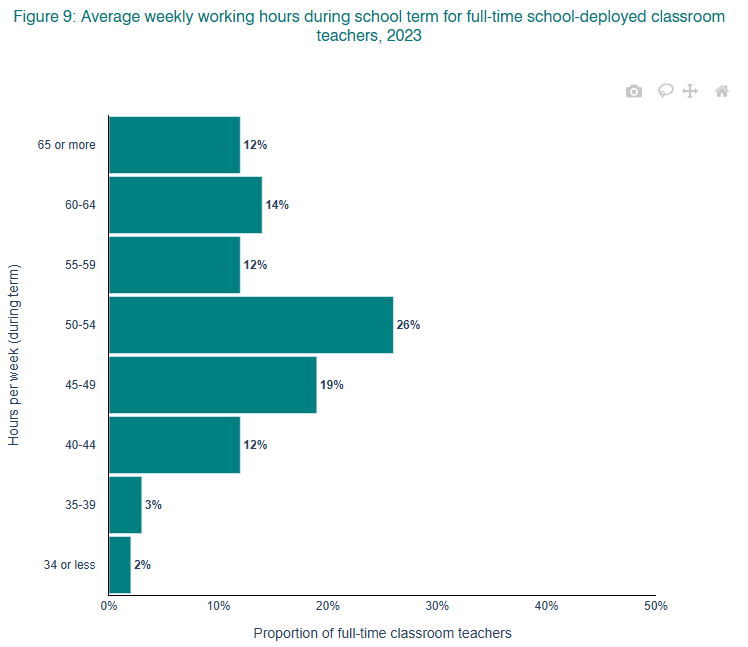
Here we see that only 5% of full-time teachers are working for the amount of hours they are contractually paid for in their salary. Meaning that 95% of teachers are completing additional work out of hours, effectively decreasing their hourly rate and greatly reducing the life element of their work life balance.
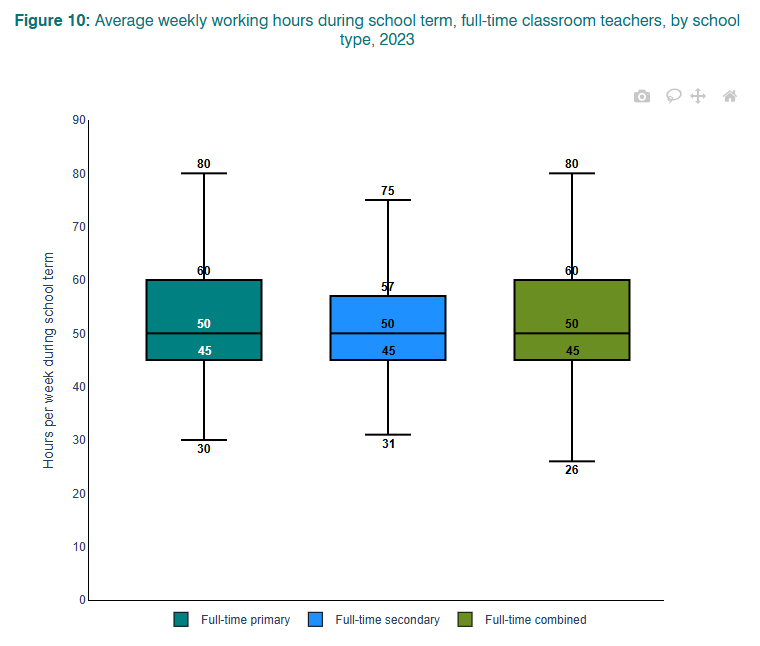
Then here we see that primary school teachers on average are working slightly more than secondary school teachers which is likely due to the increased amount of face to face teaching time they conduct each week.
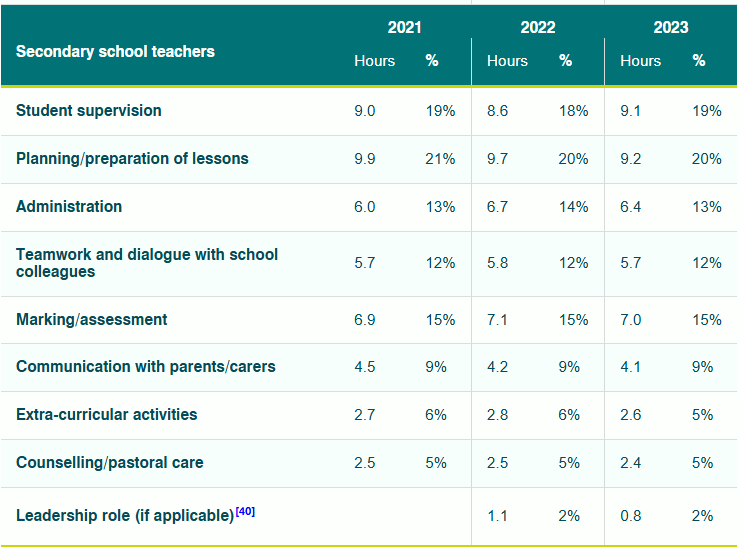
It can also be seen here that despite most teacher workload being consistent in secondary schools over time that planning/preparation of lessons has reduced which is hopefully a position indication of the impact of a knowledge rich low-variance curriculum being pursued in schools as well as the high quality shared resources available such as OCHRE.
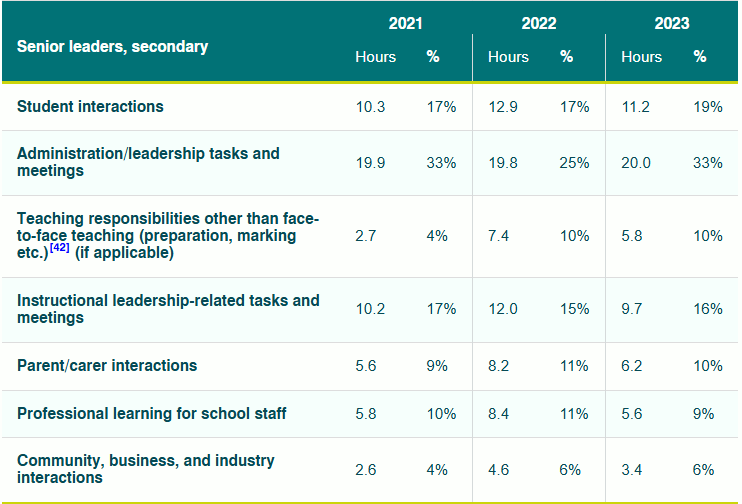
Meanwhile leaders are spending around 50% of their time in meetings which while important a lot of the time can mean they spend more time discussing rather than acting on school priorities and making the impact they ideally dreamed of when becoming a leader.
Perception vs reality
I’ve gone on record before and stated that for many teachers it is not their actual workload which is burning them out, it is the perception of workload. That’s not to say the workload of all teachers isn’t high. It’s so high that you wouldn’t be surprised to catch it at the back of the sporting field during class time with bloodshot eyes eating flaming hot Cheetos. However, as a profession we often aren’t the best at putting measures in place to make our lives easier.
I will often hear teachers mentioning that they’re under the pump because they need to make resources for their class when there are 5 other teachers teaching that exact same subject who are for some reason not all collaborating and sharing resources. There is a perception that it is a teachers autonomy to plan and teach a class the way they feel comfortable, and to a degree that is true. As I’ve argued before though, autonomy doesn’t come from creating the resources yourself, they come from how you inject your own personality and flair to bring them to life. Spending 10 hours per week making resources may mean that your lessons are a few percent more to your preference, but how many percent has your quality of life degraded?
Teacher workload based on subject allocation can be so disparate in high school as well. Sometimes a teacher may have a full load that includes 4 or 5 different classes and then a home group or pastoral care class of some variety. The composition of those 4 or 5 classes can have an enormous impact on the teachers workload. If that teacher ends up with 4 different subjects at 4 different year levels it can greatly increase their overall workload as they are now planning and assessing 4 significantly different programs for their classes. In the same school a teacher could have 4 classes but may have 2 maths classes at one year level and 2 maths classes at another. This means that they have half of the amount of planning to complete which can decrease the workload of that staff member by multiple hours per week. Additionally, although the assessment load is likely to be the same, the efficiency increases of marking the same assessment task over a larger sample is going to save time and energy in the longer run. This becomes even more difficult for ‘single subject’ teachers who need to plan, document and assess a whole subject themselves without the collaboration or help of any other staff member which takes a significant amount of time to complete.
Schools realistically need to think about how these subject allocations are likely to impact on teacher workload as teachers are more likely to do tasks that add value to student learning if they are not overburdened by doing the bare minimum.
Pruning
Last year through a random recommendation on LinkedIn, I purchased and read Dr Simon Breakspear’s & Michael Rosenbrock’s ‘The Pruning Principle’ which looks at the act of strategic subtraction in teaching. Almost a Marie Kondo of teacher time where we catalog everything we do in a day and we remove anything that does not spark joy (add value).
A huge take away I had from reading the book is that as educators we often add but we very rarely look critically at the elements of our workload that currently exist and think about how much impact each actually has compared to the time we spend working on it. Last December we actually ran a session with other school leaders talking a bout this concept and conducted an activity we stole from the book which required participants to think about the activities which take up time in their week, write them on a post-it note and then rank them based on the time taken by that task versus the value it adds.
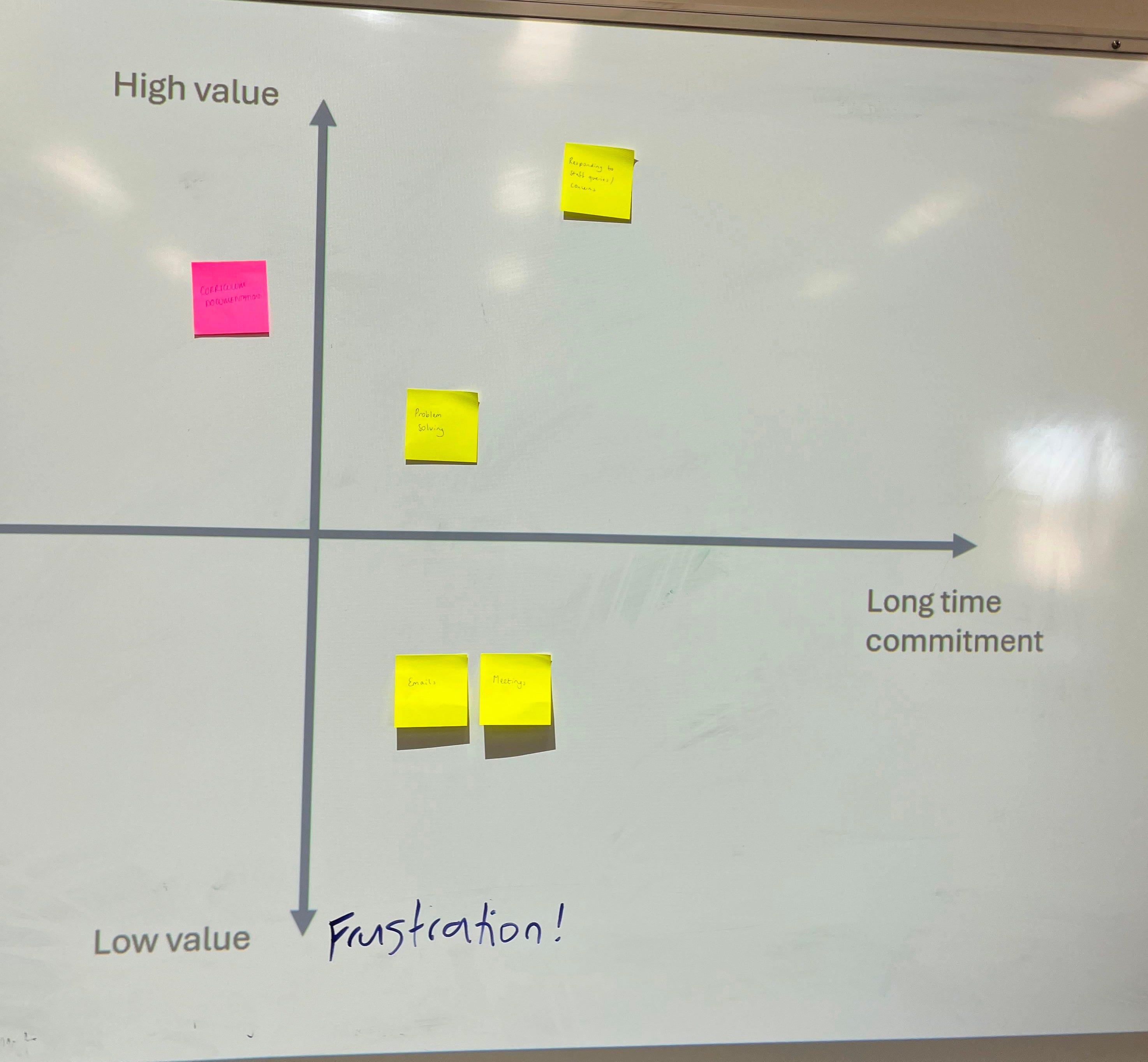
For those of you not zooming in to read the post-in notes above, you’d quickly see that some of the high time commitment but low value add activities staff were working on regularly were responding to emails, parent phone calls and meetings. Then in the area of high value but high time commitment were responding to questions from staff members. The creation of curriculum documentation was a fairly mid range time commitment to a high value add.
I think if we were to combine the high effort, low value activities you could say that they are workflows related to communication. Communication is tricky because there is a degree to which we need to communicate with various stakeholders to meet our legal obligations as schools and yet simultaneously there are sometimes three or more different channels of communication a school uses which can lead to a lot of double handling and time consumed by a teacher as they follow all of the required processes.
Many of these communication tasks are also set by school policy. Some schools may require teachers to call home to parents in regard to student performance, while others may expect an email or message from a learning management system as an update. These two activities take vastly different amounts of time for a staff member and can greatly impact on their workload.
Meetings on the other hand can be tricky as meetings need to balance the needs of school improvement or the annual implementation plan while also delivering critical information to all staff. One question I always ask when planning a meeting is “Could a staff member passively exist in this meeting and leave without needing to act on anything?”. If the answer is yes, then the meeting is unlikely to be effective and is likely to be perceived by the staff member as a waste of time and an increased burden on their workload. One reason why this can sometimes occur is that schools sometimes create the belief that staff will not read emails and therefore all information needs to be disseminated in staff meetings. This again punishes staff who want to improve and takes precious hours away from their own improvement.
Meetings having a clear purpose, actions and then follow up is so important to ensure that the time they are consuming is of high benefit for all staff.
So what can we actually take away to improve teacher workload?
Consider channels of communication:
Are there too many communication channels? Are staff needing to communicate too regularly about minor matters? Could this communication be completed by an admin staff member?
Streamlining communication means that staff cognitive load is able to decrease and they are better able to complete other duties.Commit to high level shared resources and documentation:
Having a low-variance, knowledge rich curriculum which is well documented and well resourced within schools and applied consistently amongst classes will greatly decrease the planning load on staff members. If staff are constantly having to reinvent the wheel or create specific resources for their own classes it is likely to dilute their ability to do their best teaching practice possible.
This starts with having highly detailed and comprehensive curriculum documentation such as Scope and Sequences and calendars as well as shared subject resources. These may be completed by school staff themselves or may be brought in from an external service such as OCHRE and altered by schools to best fit their context.Consider streamlining assessment practices:
Are teachers collecting student work to correct on a regular basis? Are they correcting or just sighting and sense checking homework?
This could be easily alleviated by staff conducting regular formative assessment via checks for understanding in class which allows rapid feedback for students without any extra burden on staff workload.
Additionally, I’ve worked at schools in the past which alternate which teacher will mark each area of studies assessment tasks. This means that one staff member is able to get into the flow of marking the task and then save time in future assessments.Respect teachers time:
Meeting for the sake of a meeting are not worth having and this is coming from someone who legitimately enjoys planning and facilitating a professional learning meeting.
One of the toughest parts about workload is that it often means that for teachers just to get by week on week without burning out, one of the first things to fall away is professional learning. I know just in my context I have built a whole library of absolute B.I.L.Cs1 just above my desk and it kills me that most weeks I’m lucky to be able to quickly devour a chapter as a little treat for completing another time sensitive task. When I get time to read a chapter or two at work, it feels like a game changer. I feel like I’m able to do my job so much better because of it. How often as leaders are we really able to say we’ve taken something off of a teachers plate compared to how often we’re adding to it? If we want teaching to be a sustainable career in the long term we need to acknowledge staff workload and do everything in our power to make it as manageable as possible.
Books I’d like to comprehend
One disappointing fact about the in-principle offer is that it really did little to improve outcomes for secondary teachers and therefore students. I accept meetings need to happen, however, two a week I find excessive. This is really because we could live with one. The marginal cost exceeds the marginal value. In secondary, with timetable contraints for a 7-12 school, teachers just aren’t able to collaborate within work hours. This, for me is the epic fail. I’d replace the second meeting requiring staff to use the time collaboratively. In your words “protected time”. Stunning either party in the negotiations didn’t think of it.