EI? EI? Oh!
How to sell them the cow, after they've sampled the milk.

Two inquirers and an explicit instructor walk into a staff room
Diametrically opposed
Foes1
A new phenomena I’ve noticed in teaching over the past few years is the way detractors of explicit instruction (or teaching) will have a number of straw man arguments about why they are reluctant to give it a try in one of their lessons.
Stop me if you’ve heard any of these before:
Students need to think critically
Students need to do hands on work
Students need to discover learning
Students learn better when they struggle
That’s just teaching to the test
My class wouldn’t be engaged by that
That wouldn’t work in my context
I already do that
Yet an even stranger phenomenon is when some of these teachers give an element of explicit teaching a go and report back.
Time and time again I love hearing back from these teachers about how engaged students were when they used mini white boards or that a ‘Do Now’ activity meant that class started in a far calmer manner or that students who were often passive were suddenly actively involved in the lesson. From that moment they’re relatively all in on explicit teaching after they see and feel first hand the impact it has on all students (not just the most advantaged).
Well… not necessarily all in, but more on that later.
What changed that led staff to finally give it a go?
I’d love to say that it was school based professional learning, however despite my love of crafting and presenting staff PL I’d argue that around 1% of staff change their practice based on something taught to them by a staff member of their own school. However, when external experts such as Bronwyn Ryrie-Jones or Dr Nathaniel Swain have been in town and staff have been involved in their sessions it has been transformative!
Now this is not intending to be a smear campaign on Bronwyn or Nate… they are both incredible at what they do and if they could run every staff meeting I would be very happy.
The interesting element becomes the conflict between internal and external professional learning. The difference in perception between the two can be significant as one is mandatory and one is opt-in. For anyone who remembers being a teenager, you would remember something not wanting to do something solely because you were told to do it. It’s amazing how many adults feel the same way.
I’ve made many references in the past to what I refer to as ‘shiny thing syndrome’ where staff have been burned by changing priorities spurred by the newest hotness in education that they feel a sense of reluctance to fully buy in to anything new. They’ve been in the trenches as they school launches pedagogical model after pedagogical model, each with more additional administrative changes to documentation than the last. I recall being in an instructional coaching professional learning session a few years ago which stated that only 1 in 100 teachers will actually implement a strategy when it is presented to them in a in school professional learning.
One per cent.
In Malcolm Gladwell’s ‘The Tipping Point’ he speaks of 20% of individuals needing to do 80% of the work when implementing change.
Checking in on the harvest
Curiously despite stating that once teachers pop the explicit teaching pringles that they can’t stop. Some do seem to merely see it as adding tools in their toolbelt to have more variety in their lessons. You’ll hear statements like “I used mini whiteboards last lesson and it went amazingly, I might have to plan to do that every now and then” or “I didn’t have time for checks for understanding in that lesson because there was too much content to cover”2 It makes the strategies feel like more of a novelty than an active tool of effective teaching. Further to that, the elements of explicit teaching aren’t really a choose your own adventure to build a bespoke lesson framework of your own. One of the reasons why explicit teaching is so effective because of the consolidation of routines over time. Consistency over novelty.
Further to this there is often reference to the “explicit instruction portion of the lesson”. This is a puzzling statement which shows a great misconception about what explicit teaching actually is. If you were to come to the explicit part of my lesson you’d have to be there for the whole time. Although there may be the smallest time allocated to independent practice at the very end of the lesson. Even that is a part of explicit teaching however as the lesson travels from Do Now to recap to new learning and checks for understanding on a constant short cycle gradually fading scaffolding towards independence.
Buying the farm
We’ve established though that these teachers have been willing to give it a go. Despite the hesitation to go full EI, the toe has been dipped and the temperature is inviting. So how do we invite these educators to come and swim? The first temptation is that we can see them standing on the edge of the water and we could just push them all the way in. Surely once they feel the waters warm embrace they’ll have no choice but to live, laugh and love explicit teaching.
The reality with any change however is that too much, too fast is just asking for failure. Confidence wanes and variables impacting the effectiveness rise. The chinks in the armour will become very apparent. I’m very guilty of this in the past. Shutting down opposing ideas and attempting to launch everything explicit teaching all at once without taking into account the human elements of change. I used to forget that everyone else wasn’t inside my had with my lived experiences. They hadn’t seen and experienced the incredible impact of all of these strategies, they were simply seeing a threat to the way they operate and a demand to change everything all at once.
Instead we must embrace the toe dip and gradually invite the educators further into the water one strategy at a time. No successful school change happened overnight. They happen through small, consistent, sustainable changes. Incremental improvement.
An important addition to this which I’ve reflected on this past week after being privileged enough to attend professional development ran by Dr Carl Hendrick at the Victorian Academy of Teaching and Learning that some of the key elements that lead to the failure in implementation are a lack of shared understanding around the strategies used, a feeling of requiring compliance rather than belief in the strategies and finally the segmented nature of the implementation across portfolios. This really made me think about the importance of focussing on a small area of implementation at a time. Do one thing and do it well. This was further supported by the full day professional learning we were lucky enough to have Bronwyn Ryrie Jones3 hold at our school this week which really helped to build a shared understanding of these strategies for our staff in implementing the science of learning.
One of the most common first toe dips I’ve seen in schools in recent years is the implementation and embedding of checks for understanding in classes. This can be a great place to start, partly because all teachers are likely to be doing some variation of a CFU and therefore this is tweaking and refining current practices. I am wary of this being a one size fits all starting point though as a successful launch into the EI space with CFUs requires a classroom culture of full participation and without that they’re likely to be ineffective and long term success in implementation is likely to struggle. In that instance entry routines and Do Now activities may be a better place to start to build this emerging culture.
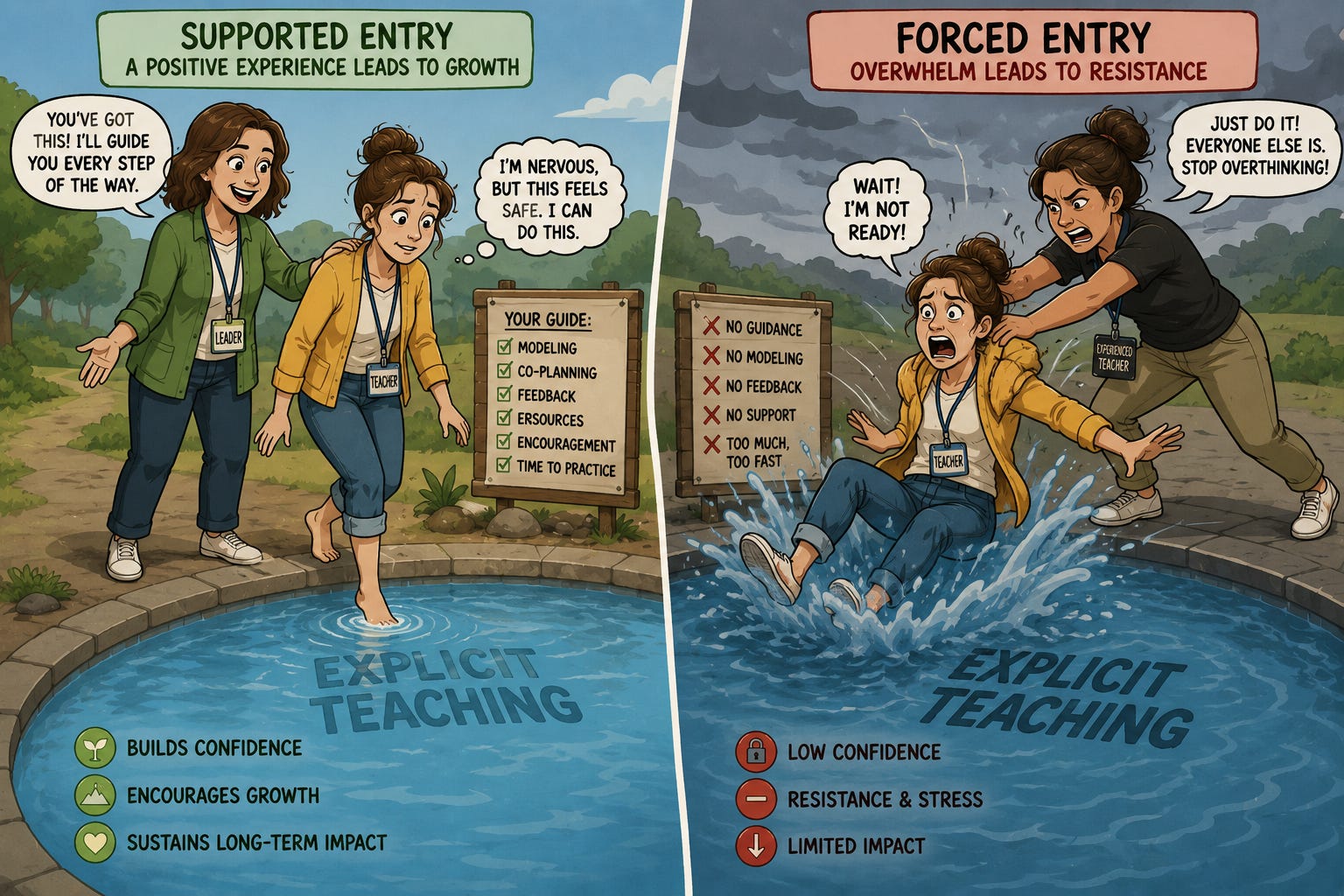
Then once this process begins, it needs to be constantly referred back to and celebrated. Those messages you receive from staff about how effective mini whiteboards were in their lesson? Make them share that in a staff meeting! Encourage staff to observe each other utilising these strategies and actually provide them the time to do it. Habits and routines are not formed in one-off trials of strategies. If anything, these strategies are likely to feel forced, uncomfortable and somewhat ineffective in their first attempt as staff struggle with the cognitive load of remembering all of the steps of the strategy itself while also juggling student participation, teaching the content of the lesson and their regular classroom management. However, with consistent feedback and reflection we can iterate on these strategies until they are second nature.
I always refer back to starting my classes with a Do Now. I’ve only been doing this for 5 years now and prior to that, the first 5 minutes of the class would be a battle. When I first implemented this strategy, it was literally just the question on the board for the students to work on while I completed the roll. Over time as students and I were more used to the process, the students would actually come in and silently begin work on the Do Now, then they’d also get out their homework for me to sight and mark off. This meant that I was able to start the class productively, while also doing the roll, uniform checks and homework checks without any additional effort. This however, took a lot of practice as well as being observed and seeking feedback. One of the simplest pieces of feedback I received was that I was spending minutes at the start of class handing out printed resources when I could just put them on a table for students to collect as they enter along with their mini white boards. To say the simplicity of this solution blew me away would be an understatement.
A past Principal that I used to work under would being every staff meeting referring to the Japanese principle of ‘Kaizen’ which refers to continuous incremental improvement over time.
Much like our students, if we want staff to fully adopt explicit teaching practice in our schools then we need to ensure they feel success early and we build on that success often. We need to embrace and highlight the early adopters and change champions within our contexts so that we can hit that tipping point between 15-20% where change goes from the few to the many.
I’ve never met a teacher that doesn’t want improvements in learning for students, we just need to make sure that we are strategic in how we push them towards change. They lightbulb or ‘Oh!’ moment is never going to arrive if we lead with “everything you think and know about education is wrong” rather than “you’re doing a lot of great things in your class room, but what if we could make them better with a few small tweaks?”.
Culture compounds.
Apologies for this, I have The Room Where it Happens stuck in my head and cannot think of the words diametrically opposed without my brain then needing to include foes. So when writing a piece related to EI vs the rest, those words were front of mind
I’m sorry… you what? Make it make sense!
It seems to have gone down well with staff too as I was worried I’d have to roll out the phrase “You (Bron) win some, you (Bron) lose some”
Yes i wholeheartedly agree! We talk about it as small big changes- like where you put the worksheets. It’s a small change with big results.
I always forget people can’t understand my brain too !