The medium is not the message.
Is this argument about delivery well done or overcooked?

I’m starting to be concerned that Microsoft PowerPoint (and to a larger extent any slide deck software) is subject to a cancellation campaign for a controversy I’m not privy to.
If you have seen a slide deck clubbing a seal or engaging in unethical labour in South East Asia please let me know.
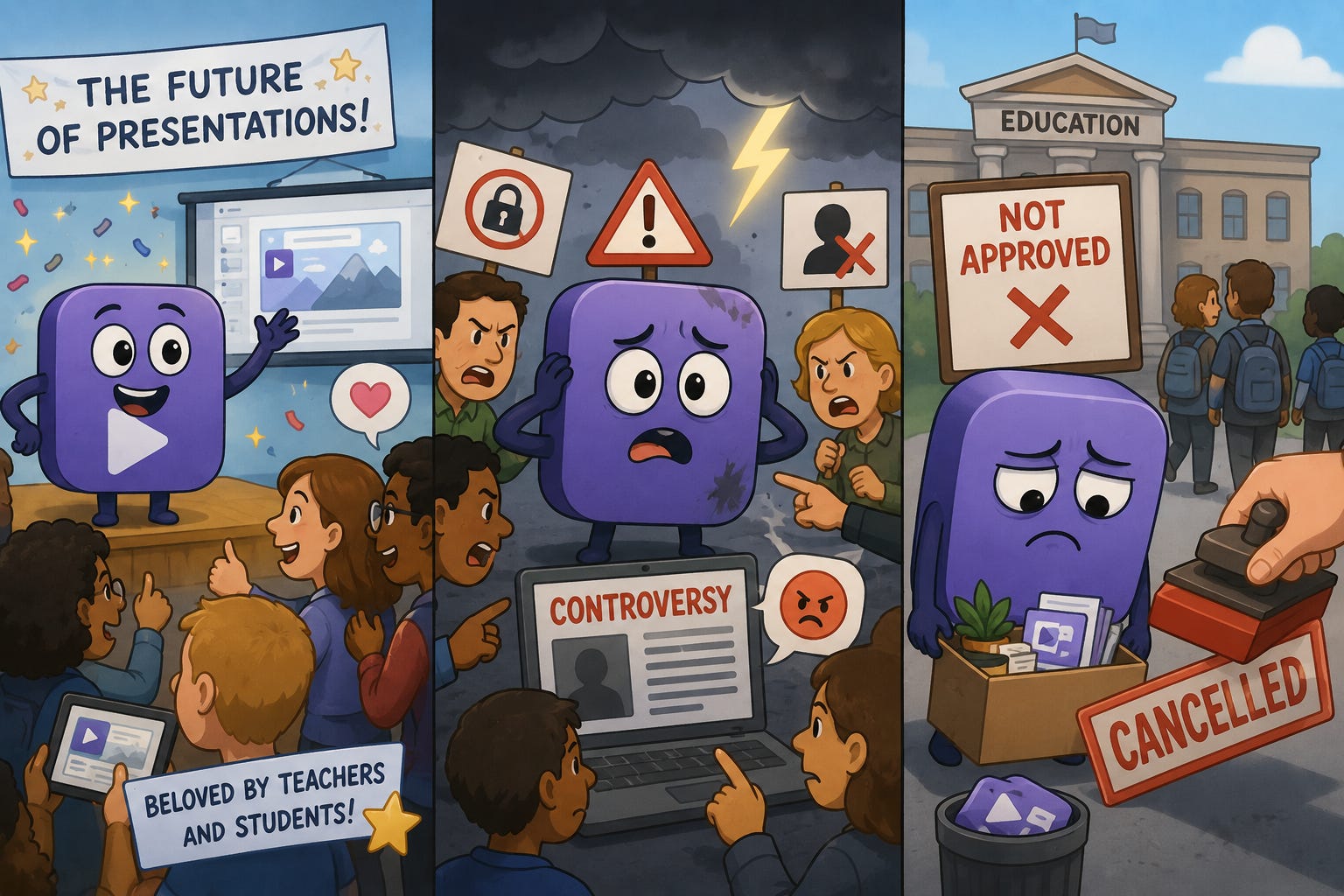
Every other day there seems to be a leading academic1 decrying the use of slide decks. Reporting on their rigidness, uniformity and inability to respond to the needs of the students in front of them as they serve but one purpose to propel the lesson forward whether the students understand or not.
But is that really the slide deck doing that? Or is it the teacher in the room?
Is PowerPoint the instruction or merely a tool for the delivery of it?
I’m of the professional opinion that any instructional tool is only as effective as the expert using it. So let’s explore the many different instructional options and what they look like done well as well as poorly.
Consistent evidence is found for the generalization that there are no learning benefits to be gained from employed any specific medium to deliver instruction. - Clark, R.E., 1983
The Slide Deck:
You could call me a PowerPoint apologist. I’ve used slides my whole career. I genuinely enjoy the process of creating, crafting and sequencing a lesson in slide form. It has gotten to the point where on vibes alone I can create a lesson in slide form with embedded checks for understanding that will go for exactly the time I need it to. Time bends at the whim of the slides I create. Present, past and future all collide in the service of delivering instruction.
Are slide decks perfect?
Well obviously not. Even the slide decks I love this year, I will look at in a few months time and think of all of the ways I can iterate on them to improve the sequence and flow. This is a skill that can only develop from a place of subject expertise. Comparatively a novice teacher may struggle to do this and therefore will more rigid and constrained to the words on the screen as the lesson propels forward regardless of impact.
When done well:
A slide deck which is well constructed and executed can foresee potential misconceptions of a class and over plan with ways to respond to student needs which may arise based on student understanding or lack there of.
An expert teacher will be able to edit and add to the presentation as needed in the moment as well as update and improve the presentation for future cohorts. This expert teacher will also bring the words on the page to life with their own examples of anecdotes to help strengthen student connection to the content2.
The slides can also create a classroom that is somewhat of a tennis match as the teacher serves up some knowledge and the students return serve showing their understanding so far, the teacher then lobs it back with an extra layer of depth and this dance goes on back and forth for the better part of an hour. It doesn’t feel like an hour however as the constant thoughtful transition between instruction and application causes time to melt away.
When done poorly:
A poorly crafted slide deck can be not only an overstimulating sensory nightmare when it has been over engineered for the ‘benefit’ of student engagement, it can also have the potential for a teacher to robotically read the slides verbatim and push on regardless of the signals being sent to them by students.
A poorly implemented low variance approach can lead teachers to feel chained to the resource rather than free to bring the words to life through their own personality.
Implemented poorly, slides are where enjoyment in learning goes to die.
But still, even poorly designed and implemented slides are better than nothing.
OneNote:
I’ve been informed by many maths experts I know that OneNote is the G.O.A.T.3. The ability to live model while thinking aloud to students to demonstrate the procedural knowledge required to complete problems has a level of natural flexibility which would take significantly longer to achieve via animations in a slide deck.
OneNote also gives you infinite workspace in every direction to explore more complex thinking or adding additional problems or examples to strengthen understanding.
Personally, I avoid OneNote as a learning tool solely because we’ve used it for so long as a resource organization tool as a faculty level (which it is a nightmare for) that I’ve never given it the time it deserves as an instructional tool.
When done well:
OneNote utilised well for teaching can create an environment where the teacher brings learning to life by explaining their thought process aloud while live modelling the procedures of responding to questions or tasks. Additionally, in subjects such as English and the Humanities it allows for in detail analysis of sources where teachers are able to model annotating and making meaning from text in a way that is more difficult to do on a slide. This can create a living and breathing page which can ebb and flow with the needs of the students in front of the teacher on the day. If the students are unable to show understanding after a worked example, the teacher can easily create another directly next to it in the infinite space that OneNote provides. After the completion of instruction all of these models are then permanently etched into the class OneNote to be referred to in future.
When done poorly:
OneNote utilised poorly is essentially just words on a page. This could mean that the examples are already pre-filled and the teacher simply talks through them with no meaningful generation of the procedures which are important for their completion. Poor instruction via OneNote can also become difficult for a student to comprehend as the mess of teacher notes or instructions can defy logic as the sprawling text covers the infinite void of the OneNote space.
Visualizers/Document Cameras:
To be completely transparent, the way in which visualizers are utilized in class are not that different to how OneNote is used when used well. Where they could get a competitive edge with some educators is the ability to display literally anything.
Student work sample? Common misconception? A tattoo of an Asian word the Balinese tattoo artist assured you was ‘destiny’?
You can show them all with ease and speed in a way which the whole class can then see. This differs greatly from the aforementioned mediums which more preference displaying mainly the teacher’s hard work to benefit learning.
When done well:
This technique captures the live modelling of think alouds better than any other strategy I’ve witnessed in the way it is generative and the teachers ideas come to life from thin air4. A well used class with a document camera can seamlessly float between instruction, checking for understanding and celebrating student exemplar responses without as much pre-planning required for the teacher as a slide deck would. Even better is that most modern document cameras can record the video or key images of the completed models so that they can be kept for eternity.5
When done poorly:
It took me months to build up the confidence to use my document camera with a class as the number of transitions I needed to go between the software, my checks for understanding etc meant that I was worried it would throw off the momentum in my lessons. Implemented poorly then the camera is just another blank slate white board where the teacher throws together a lesson built on good intentions without much actual intentionality.
Chalk and Talk:
The vintage classic. No technology, no gimmicks, just a teacher, a marker and a board with infinite potential. This is how I received my education and I sure turned out fine6. Despite rarely involving real chalk anymore, this approach can still be quite effective in the right hands (and vocal cords). This involves the teacher simply verbally instructing the students and writing all important points onto the board for the class.
When done well:
A well delivered chalk and talk can sequentially build layers of understanding of a complex topic which never overloads working memory. Information only appears when it becomes relevant and all old information remains visible rather than transient. This can provide students with optimum opportunities to rehearse the content in hopes some may transfer to long term memory.
Done well it can create elaborate mind maps like semantic networks which connect countless pieces of previously disconnected information in a meaningful way to improve student understanding.
When done poorly:
Basically just a lecture.
Information as transient as a nomad.
Knowledge which must be caught, not taught.
One of the key fears with chalk and talk is that the instruction can be incredibly high variance between teams and once the chalk is erased then the incredible work of the educator needs to be recreated from scratch in future attempts at the same lesson.
Research/Inquiry Learning:
I have a pretty bad habit of demonizing inquiry based learning much the same as I bemoaned the way in which the internet seems to be metaphorically shoving PowerPoint into a locker. Inquiry can actually lead to incredible rich learning experiences. The caveat however, is that it cannot be used with novice learners.
At the end of a lesson sequence with relative experts? That’s amorè.
Inquiry with novices? That’s a recipe for inequity.
The reason why is that novices do not have the pre-requisite knowledge required to ask the questions needed to inquire meaningfully as well as filter the seductive details which may not be relevant to the required learning.
When done well:
Well executed inquiry will ironically require one of the above explicit teaching methods executed to a high standard directly before it. This way the students have all of the required tools in their arsenal to ask the right questions and feel capable of diving deep into the learning while having the capacity to filter through sources of varying quality. This would not just be sending students off to conduct open ended research either, there would be constraints and clear structure provided to the inquiry task. This could exist in the form of guiding questions or clear criteria which the students need to address in their research to ensure that a consistent depth of understanding is created amongst the class regardless of the area they have explored.
When done poorly:
I previously referred to open, un-guided inquiry as a class of free range eggs. This classroom could actually create the illusion of engagement and learning as students work away busily on their devices where they’ve been set to ‘inquire’ about a topic of their choice. This can widen the achievement gap in classes as the previously privileged students have the background knowledge to inquire regardless of the teachers capability in preparing them while the less advantaged students do not even know where to start.
When I first started my teaching career I referred to this as ‘productive chaos’ which was a completely inept description by my past self as in reality it was just chaos as students use any opportunity to work on anything other than the task as hand. Sometimes a week of class time could be allocated to completing a research task and within that hour I’d argue that some students use half an hour or less of that time productively. That means that almost 10% of a terms potential learning is lost in the guise of having a student centred approach to learning.
So many academics have used the analogy that learning is a lot like training to run a marathon. Training, must like teaching can look very different for different individuals based on where they’re currently at and their end goal. To put all of our eggs in one basket and say that one training plan is the only real way to build up to run a marathon would be crazy. There are a countless number of factor which may impact the strategies used by an individual in the lead up such as time, prior experience, available resources etc. Which are not dissimilar to the factors which may impact the medium teachers use to deliver their instruction.
The medium is not the message.
Any tool can be effective in the hands of the right person.
Media are mere vehicles that deliver instruction but do not influence student achievement any more than the truck that delivers our groceries causes changes in our nutrition. - Ibid
Or a loudly opinionated LinkedIn/Substacker… hey that sounds just like me.
Even better would be if they add the story into the notes section if it’s particularly good and worth stealing by other teachers.
Greatest of all teaching tools
Which is most likely a very careful plan.
Or until our eventual AI overlords remove us from the digital space.
Nobody explore this any deeper.